By Angela DiGiulio and Martine Burtis, UVM Students and Members of UVM Student Labor Action Project (SLAP)
On Friday April 27th, twelve UVM students from the Student Labor Action Project ended a five day hunger strike to urge the University to adopt livable wages for all workers on campus. The information presented on current compensation packages as well as subsequent media coverage, confused the message on whether UVM is paying a livable wage or not. Some of the media also incorrectly characterized our response to new wage calculations as "being confused" or "unaware" of current wages at UVM.
The reality at UVM is that a gap still exists between the lowest paid UVM workers and a livable wage. Also, other workers contracted by the University to work in our cafeterias or to construct new buildings on campus make less than a livable wage.
In the spring of 2006, a taskforce convened to study the livable wage issue and to examine the current compensation package at UVM compared to current livable wage figures published by the Joint Fiscal Office (JFO). The taskforce issued a well documented study that adjusted the livable wage, to account for unique benefits offered by UVM. The taskforce found that the livable wage figure for UVM would be $12.28/hr.
Shortly thereafter, President Fogel announced that a recent contract with service and maintenance workers set a base wage of $10.60/hour that was close enough to the livable wage figure. At that point, Fogel stopped being willing to work talking with members of SLAP regarding the taskforce's livable wage figure.
As a result, this April SLAP constructed a tent city in front of Royal Tyler Theater to bring more attention to the remaining wage gap at UVM. This was the second tent city in two years to raise awareness on about livable wage issues. With no movement from the Administration, we began a hunger strike on April 23rd.
In response, the University called upon the Vermont Joint Fiscal Office to calculate a livable wage adjusted for UVM's benefits. Unfortunately, once we had time to review the calculations, we found that JFO had deviated from the methodology mandated by the legislature by deducting the value of benefits that are not included in the basic needs budget. For example:
1) Tuition Remission. UVM offers tuition remission for employees who wish to take courses as individuals or wish to send their children to UVM. However, there is no education expense included in the basic needs budget assumptions that UVM's tuition remission program can offset. Thus you cannot lower the livable wage figure based on this benefit. Moreover, while tuition is a major expense for some people, does not help someone meet their basic needs. You cannot eat tuition!
2) Long-Term Disability Insurance. Again, this is a valuable benefit for UVM workers, but the basic needs budget does not include any such cost in its assumptions.
3) Retirement and Health Care. The revised JFO livable wage figure also contained miscalculations when comparing UVM's retirement and health care benefits to the basic needs budget.
In summation, the revised figures produced by JFO and presented to SLAP and the Administration are not true to the approved methodology. We were not confused, especially upon reviewing the newest variation of the calculations, about our commitment to demanding that UVM adopt livable wages and close the wage gap once and for all.
We continue to support the findings and recommendations of the taskforce. Indeed, it is clear that a significant wage gap still remains at UVM. We would like to clearly state that UVM still needs to address livable wage and workers' rights issues on campus, some of which they have tried to ignore. Perhaps most importantly, UVM also has not addressed the issue of contracted workers-the poorly paid Sodexho workers (starting pay is around $8/hr or $9/hr) or wages of the numerous construction workers working on building projects on campus. Currently, there are no guidelines or standards for how the workers UVM contracts are treated. UVM has made the choice to contract out jobs, like food service workers, and they have been resisting setting any standards to how those workers are treated. UVM has established "green building" standards on all their new construction. We are asking them to adopt fair employment standards for every contractor they hire.
We call upon UVM to uphold their social justice mission and principles and make a good faith effort to reopen discussions on livable wages. To really fulfill the claims that UVM is one of the "best employers in Vermont," "committed to sustainability" and upholds social justice principles, it must look honestly at what is paid to all workers-contracted and non-contracted workers-and make sure people can meet their basic needs.
Based on partial data from the State, the Vermont Guardian reported in 2005 that 161 UVM workers received public assistance. Hundreds of contracted workers are forced to rely on public assistance, because of the low-wages paid by UVM's contractors such as Sodexho. In the end, UVM can either pay their workers a livable wage or shift the cost to taxpayers.
More info on Student Labor Action Project at UVM
UVM Livable Wage Figures Misleading, Gap Still Remains


A Truly Memorable Annual Dinner & SLAP ends Hunger Strike

By James Haslam
On Sunday April 29th over 150 people came from all over Vermont to the Old Labor Hall in Barre to celebrate the 9th Anniversary of the Vermont Workers' Center - Jobs With Justice. For folks who couldn't make it, I'm happy to report that we'll have video excerpts on our BlipTv website very soon, and they are worth watching, especially Elaine Bernard and the three Iraq Veterans Against the War. The best way I can describe the experience, is to say that the Workers' Center dinner brings all kinds of great people together, some of whom have just met or don't see each other except this once a year celebration, so there is often a small degree of quiet chatter that goes on during the event, even when it is time for listening. But for the entire time the veterans were speaking you could of heard a pin drop, as people were capitivated with their horrific accounts of what they had seen and their new fight to end the war immediately. 
Below, speaking Iraq Vets Against the War members Drew Cameron (Burlington, VT) with Adrienne Kinne (Sharon, VT) and Matt Howard (Burlington, VT).
And Elaine Bernard was really inspirational, be sure to stay tuned for us to get the video online. 
We honored all the Solidarity School graduates, COTS workers and Verizon workers fighting to Stop The Sale. We were also proud to honor(AND FEED!!) a big group of the Student Labor Action Project (SLAP) folks who ended their hunger strike for livable wages last Friday. What they have been doing over the last three years leading up to the hunger strike has been amazing. The amount of public education about livable wages, social justice and solidarity was truly enormous as their fight became known widespread in the community and throughout the country. The rally on Friday was awesome, uniting UVM workers, multiple local unions, community members and more and more students have become involved in this movement for livable wages and workers' rights. We look forward to work SLAP in the many more battles ahead at UVM, as we make the entire City of Burlington and State of Vermont truly livable for everyone.
By the way, anyone who saw the Free Press and/or WCAX coverage of the end of the hunger strike likely had a similiar reaction that I did, one of confusion and mixed with a good deal of anger (the one very notable exception was the great article in Vermont Guardian). It was really negatively spun and not entirely accurate, but a big part of this was due to the fact that Legislative Joint Fiscal Office (JFO) produced some very misleading numbers discounting what UVM's livable wage should be and basically acted as the UVM Administration's spin doctor to help them justify paying below the livable wage. Since the JFO itself calculates these basic needs numbers, when this information was presented to the students it obviously led to confusion. We are working with the VT Livable Wage Campaign and Doug Hoffer (see his report) to get the real facts out, mainly that things like higher education benefits and disability benefits cannot be used to discount the basic needs budget when those costs are not part of the basic needs formula. Or as UVM Service & Maintenance workers' union, UE Local 267 put it, "you can't eat benefits".
Here's what SLAP had to say when they ended the strike.
Excerpt from SLAP Statement ending the Hunger Strike: "We have emerged from this struggle victorious – we began following a blatant denial by the administration that compensation for underpaid workers on this campus was an issue, and we ended with a commitment by the administration to continue working on this issue and a videotaped statement by Fogel that the livable wage issue will be significantly considered moving forward.
This is not the end. We will continue to promote and defend the rights of the under-compensated workers on this campus, today, tomorrow, and at everyday into the future. We have secured a firm commitment by the administration to put a renewed focus and effort on this issue. And we will remain vigilant in ensuring that the administration follows through on their promise.
The end of the hunger strike marks a significant and measurable victory in the history of equitable compensating on this campus. We hope to open a new chapter in negotiations with the administration, and will ensure that they follow up on the promises they made today.
We want to thank the entire UVM and Burlington community for their outpouring of support during this challenging protest, and wish to assure everyone involved that we have emerged with a significant victory that addressed the reasons for which the hunger strike began."
Support SLAP Hunger Strikers At UVM

Twelve members of the Student Labor Action Project (SLAP) started a Hunger Strike on April 23rd demanding livable wage policies at University of Vermont. For the past two years, SLAP has been fighting for livable wages for all UVM staff and policies to ensure that all UVM contractors pay workers at least a livable wage. They have also been fighting fair employment policies to protect workers' right to organize and responsible contractor policies specifically for construction projects.
Here is link to TAKE ACTION:
Solidarity Activities This Week:
WEDNESDAY: Call-in day, everyone call or email President Fogel and tell him to pay livable wages now! daniel.fogel@uvm.edu, (802) 656-7878
THURSDAY: Solidarity fast! Commit to fasting for the day to show solidarity with the strikers.
FRIDAY: Large rally on the steps of Waterman at noon! South Prospect Street
SUNDAY: Come honor their determination at VWC Anniversary Dinner 5pm, Old Labor Hall, Barre (See details below)
Monday's Burlington Free Press Front Article & On-line Poll
Free Press Coverage of Day 2
UVM Student Labor Action Project Website
Come to VWC Annual Dinner - 5pm, Sun, 4/29 Barre Old Labor Hall

Come join the fun and the fight for workers' rights. Great food, great people. Celebrate the 9th Anniversary of the Workers' Center, special guest speakers include Elaine Bernard and Iraq Veterans Against The War - Drew Cameron and Matt Howard. Questions: 229-0009 or info@workerscenter.org
150+ brave weather to March For Livable Wages!

Calling for livable wages and public policies that produce real family supporting jobs, over over one-hundred and fifty community members with representatives of over a twenty different local unions march and rallied thoughout Burlington on Saturday. 
The rally started at HO Wheeler Elemntary School where Burlington School Custodian Karl Labounty and other school support staff spoke about their fight for livable wages. The contracts for the Burlington School custodians, food service workers and paraeducators expire at the end of June. Stay tuned to help in this struggle for livable wages..
The March went down Church Street, where hundreds of people work in multi-national corporations who could easily afford a livable wage. Note the delegation of the Student Labor Action Project (SLAP) in the photo. SLAP has been leading a multi-year campaign to establish livable wages for all UVM employees and workers at UVM working for contractors like Sudexho. Stay tuned for developments in this struggle. Next the march headed to the Verizon Building on Main Street to to rally to stop the sale of Verizon (www.stop-the-sale.org ). 
And then up the hill to UVM..
Outside Tent City Student Labor Action Project leader Kat Nopper speaks to the crowd about the campaign for livable wages and fair employment policies at one of Vermont's largest employers. UVM has been spending hundreds of millions of dollars on new construction, and the VWC and SLAP has been leading a campaign to get the administration to care about the quality of jobs they are creating to build these buildings. To learn more abou the Burlington Livable City Campaign email james@workerscenter.org.
Why U.S. Trade Unionists Should Attend the U.S. Social Forum
An article by Workers' Center Coordinating Committee member and UE leader Jonathan Kissam in MRZine:
http://mrzine.monthlyreview.org/kissam100407.html
Solidarity School 2007

The Vermont Workers' Center finished its first-ever 3-day Solidarity School on March 15th. Participants from numerous area unions, including the NEA, UE, United Staff (UVM), Laborers, Ironworkers, IBEW, VSEA, and others, spent three full days over the course of a month discussing contract campaigns, membership mobilization, cross-union solidarity and "big picture" items like health care, retirement security, the war and movement-building.
The school was a result of the Workers' Center's fall 2006 strategy retreat, which identified leadership development as a key priority for our work in 2007.
More photos can be seen in our photo album.
Take Action: Urge COTS Board to Do the Right Thing
Please tell the COTS Board of Directors, that there is still time to do the right thing by COTS employees. UE has filed a petition with the NLRB to hold a Union representation election at COTS, but management still has the opportunity to voluntarily recognize the UE as the representative of COTS employees and save the workers and the agency the expense and distraction of another election process.
It would be shameful for COTS to spend time and money on fighting the decision its employees have already made.
Take Action Now
Learn More
Burlington Free Press article
180+ Attend February 19th 2007 Vermont Workers Rights Board Hearing

Burlington - No amount of snow could hold back over one hundred and eighty people attending the 2007 Vermont Workers Rights Board (WRB) Hearing on “The Race To The Bottom” at Burlington City Hall. Organized by the Vermont Workers Center and Vermont Livable Wage Campaign, over two dozen people testified from a broad range of different jobs, including local school support staff workers, nurses, teachers, restaurant staff, construction workers and people who work for UVM, Verizon, COTS and other large local employers.
While hearing the many stories of the struggles of people trying to support their families on poverty wages and the impact on losing their jobs to corporate globalization, the emphasis on the evening was on pushing for positive change. The Burlington Livable City Coalition includes a broad range of local unions and community organizations who are committed to truly making Burlington work for everyone. With active campaigns to establish livable wages for all staff and contracted workers at UVM, school support staff workers in Burlington, including paraeducators, cafeteria workers and custodial staff fighting for livable wages, efforts to establish Responsible Contracting construction policies at local public institutions, legislation to increase the Tipped Worker Wage and to protect all workers falling under the Vermont labor law have the right to organize – the fight to reverse the race to the bottom is on. Email info@workerscenter.org to find out how to get involved.
WRB members included Sen. Bernie Sanders, Burlington Mayor Bob Kiss, Rabbi Joshua Chasan, Rev. Roddy O’Neil Cleary from the Burlington Unitarian Universalist Church, Rev. Michael Cronahue, Society of St. Edmundites, State Rep. Mark Larson (D-Burlington), State Rep. Floyd Nease (D-Johnson) , State Rep. Helen Head (D-S. Burlington) , State Rep. Chris Pearson (P-Burlington), State Rep. Jason Lorber (D-Burlington), State Rep. Rachel Weston (D-Burlington), State Rep. Johanna Leddy Donovan (D-Burlington), State Sen. Diane Snelling (R-Chittenden) and Burlington City Councilors Jane Knodell and Tim Ashe.
Media coverage:
Channel 3 - CBS news (with video)
Burlington Free Press
Audio of Vermont Workers' Center TV Show
The Race to the Bottom
Jonathan Kissam
Most working people in Vermont are faced with economic insecurity on a daily basis. Fewer and fewer workers enjoy health care coverage, real retirement security, or even a livable wage. Too many workers are forced to work two to three jobs, taking a toll on families and communities. And we are seemingly always caught between the rock of rising regressive taxes (such as the property tax, sales tax, and user fees) and the hard place of cutting public education and public services -- illustrated no more clearly than in our Vermont town meeting debates over school budgets every year.
Some people, especially the few who are benefitting from the situation, would like us to believe that economic insecurity for the many is simply a byproduct of uncontrollable forces of the economy, and that there is no other option to the status quo. However, the reality is that economic insecurity is a result of specific policies promoted by large corporations, the wealthy and their far-right allies. Federal trade policy has promoted outsourcing, off-shoring, and plant closings that have devastated many communities. Health insurance and pharamceutical companies have poured millions of dollars into defeating any kind of health care reform. Billions of dollars have been wasted on an unneccesary and unjust war in Iraq. These policies add up to a "race to the bottom" for workers, and a race to the bottom is one that no one wins.
Throughout history, whenever economic elites have defended the status quo with the argument that there is no other option, working people have stood up for an alternative vision, a vision of an economy that works for everyone. We can see that happening locally in the Verizon workers who are standing up to stop a sale that could not only destroy good jobs but frustrate Vermont's aspirations for quality broadband, in the fight that Specialty Filaments workers made for a just severance when their factory closed, in the struggles of nurses at Fletcher Allen for quality care, of COTS workers for a voice at work, and of school support staff for livable wages.
On February 19th, the Vermont Workers' Center, the Vermont Livable Wage Campaign, and dozens of other local sponsoring organizations will be holding a Workers' Rights Board Hearing, where elected officials, faith leaders and community leaders will hear testimony from those workers, and engage in a critical community discussion regarding poverty wages, livable wages and the future of jobs in our community. It is only by linking our struggles together to create a common vision of economic and social justice, and a movement based on that vision, that we will be able, as a community and a nation, to stop the race to the bottom.
Jonathan Kissam is Secretary-Treasurer of UE Local 221, the Vermont Nonprofit Workers' Union.
Don't Break My Heart with the US-Korea Free Trade Agreement!

Today, a small delegation of activists from the Vermont Workers' Center and Students for Peace & Global Justice at UVM braved a snowstorm to deliver a Valentine's Day message to Vermont's Congressional Delegation: "Don't Break My Heart with the US-Korea Free Trade Agreement!" The action was in solidarity with the week of action organized by Korean-Americans Against War and Neoliberalism. The US Trade Representative's office is in a 7th and possibly final round of negotiations with South Korea this week in order to create the largest free trade agreement since NAFTA (more information on the proposed agreement).
We first tried to visit Senator Patrick Leahy's office, but his staff were apparently more deterred by the blizzard than we were, so we decorated the outside of the office door for them, and slipped the rest of the 100+ Valentine's cards we had brought for the Senator under the door.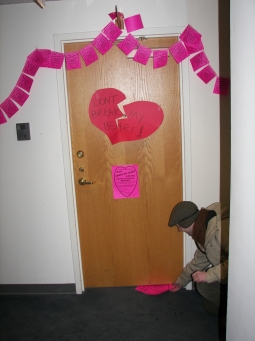
Then we visited the office of Congressman Peter Welch, whose staff cheerfully accepted the Valentine's cards and told us that the Congressman has been asking a lot of questions about the US-Korea free trade agreement and issued several major statements supporting fair trade in the past few weeks.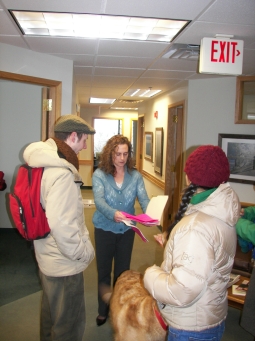
Finally, we were cordially received at the office of Senator Bernie Sanders, a long-time ally of working people, where his local chief-of-staff assured us that Bernie would lead the fight against this and any other unfair trade agreements in the Senate, and that he felt good about taking on that fight in the Senate as several strong fair-trade advocates had been elected in November.
Feb 19 Workers Rights Board Hearing: The Race To The Bottom (Bernie Sanders will be speaking)
Vermonters Facing The Race To The Bottom
Vermont Workers Rights Board Hearing with Senator Bernie Sanders
6:30PM, Monday, February 19th
Contois Auditorium, Burlington
Where did the good jobs go?
Should every business pay a livable wage?
How many of us are working full-time for poverty wages?
How do we support and create more livable wage jobs?
How do we raise the bar for wages in low-wage sectors in Vermont?
COME SPEAK OUT!!
The Vermont Workers’ Center and Vermont Livable Wage Campaign along with dozens of other local sponsoring organizations would like to invite your organization to this important event. The Vermont Workers Rights Board is made up of dozens of elected officials, faith leaders and community leaders. Come speak out and hear testimony from area restaurant & hospitality workers, area school support staff, construction workers, laid off factory workers, workers at UVM, Fletcher Allen, Verizon, COTS and many more. Please come participate in this critical community discussion regarding poverty wages, livable wages and the future of jobs in our community.
If you would like to learn more you can contact:
James Haslam, Vermont Workers' Center at 802-272-0882 or james@workerscenter.org
or
Emma Mulvaney Stanak, VT Livable Wage Campaign at 863-2345 ext. 8 or livablewage@pjcvt.org
Worker Center V-P Raps War in Iraq & War at Home
Speech given at Montpelier Anti- War Demonstration Jan. 20th - rough transcript:
I’m Dawn Stanger. I’m a Teamster who works up at UPS and I’m Vice President of the Vermont Workers’ Center. The Workers’ Center usually struggles locally, trying to gain power for Vermont’s workers, but we can’t ignore global issues. We are an affiliate organization so many unions in Vermont support our work.
In the past the labor movement pretty much supported U.S. wars. But the military consumes half of our tax dollars, and gets our brothers and sisters killed, and we knew that Iraq had nothing to do with the crimes of 9/11. It was obvious that this would have a huge effect on our friends and co-workers who’d be called up. So we joined a group called U.S. Labor Against the War back in January of ‘03’. Shortly thereafter, Vermont’s AFL-CIO also affiliated with USLAW and there’s now hundreds of union locals across the country calling for Troops Out Now.
Death and violence still hang over Iraq, post-Saddam, and union leaders are still being murdered but their fears have multiplied a hundredfold. They say that they still have a chance to get back to that secular society, if we get out now. They see us as the cause of the sectarian violence. And USLAW sees no choice now but for the Democrats to cut off the funding. Bush is crazy, offering us an escalation. After that election. No way. Not one more life. Not one more dollar, but what it takes to bring them home safely. Iraqis voted for those who promised to get us to withdraw. Yet almost immediately, those they elected were singing a different tune. What happened, they must wonder.
Congress created a fund to take care of the heroes of 9/11, workers who raced into Ground Zero before and after the EPA said it was safe. Then we discovered the truth; it wasn’t so safe and the EPA knew it. But they wanted Wall Street up and running. 32,000 workers are still suffering serious health effects, and their funds are running out, while we spend billions in Iraq. ¼ of this war’s budget would have fixed Social Security for 75 years. We maintain that Iraqis and us have the same enemy – greed.
And the conclusion is that we all need to struggle together, workers in every country. We need to try to make Reverend King proud of us as we root out racism and classism. We need to figure out a way to fix our democracies before we fly around the globe spreading bs. We’ve got imperial aims and we can’t even take care of ourselves, Katrina being the glaring example. I can’t believe they’re now talking about expanding the military – both parties. No. Not until the corporations get out of our government. They’re about to sign agreements to privatize Iraq’s oil - agreements meant to last 30 years. We‘re building military bases there, one of the things that has been acknowledged by the “terrorists” as a cause of terrorism. And we’re threatening Iran now with air strikes. Madness. Being done because someone, somewhere, sees a profit in it.
Bush is not the problem, though, but the symptom. The real disease is corporatism. A country that’s run by corporations is not one that cares about Vermonters who enlist for schooling, or because they can’t find a decent job. And the biggest risk is the moral and financial bankruptcy of the country. Where is the truth? We need to investigate how we got where we’re at, and pass laws to ensure we don’t get here again.
Verizon Sale Announced
The Communications Workers of America (CWA) learned
late on Monday, January 16, of Verizon’s plans to
announce today that they will be selling their Vermont
landlines to Fairpoint Communications. While details
are still emerging, it is a requirement that any such
action be approved by our Public Service Board. The
CWA intends to obtain party status in these hearings
to assure that the concerns of our members and Vermont
rate payers are addressed through the PSB process.
While testifying before the Vermont Senate Finance
Committee on January 9, PSD Commissioner David O’Brien
stated that any approval would be for a level of
service and access that is better than what we
currently have. He also stressed the importance of any
buyer having essential financial resources available.
Among the CWA concerns are:
- How can we protect telecom jobs, service quality,
and regional economic development that depends on
broadband connections?
- With Verizon leaving our state, what's the future of
high speed broadband service In Vermont?
- How should state legislators and regulators respond
to Verizon's abandonment of its "low-value" landline
customers?
- How can labor, small businesses and consumers fight
rural telecom red-lining and achieve hi-speed internet
access for all?
- Will the resulting fragmentation of the bargaining
unit have a harmful effect on contract negotiations in
2008?
As part of the effort to oppose the sale of Verizon’s
landlines in Vermont and to be included in the
regulatory process, the Communications Workers of
America Local 1400 and International Brotherhood of
Electrical Workers Local 2326 are holding a
legislative reception in the Statehouse cafeteria on
Wednesday, January 25th from 5:00pm to 7:00pm.
CWA Research Economist Kenneth R. Peres, PhD will be
the featured speaker and local Vermont Verizon
employees will be present to discuss their concerns.
For more information, contact Ralph Montefusco at
802-598-5613.
------------------------------------------------------
Ralph J. Montefusco
172 Woodbury Road
Burlington, Vermont 05408
802-598-5613 (Cell Phone)
802-862-4085 (Home Phone)
COTS board needs to do the right thing
COTS board needs to do the right thing
Burlington Free Press
Published: Tuesday, December 12, 2006
By James Haslam
Here’s the point that the Committee on Temporary Shelter (COTS) Board of Directors and some others have missed, the vast majority of the 46 COTS employees have already formed a union. Back in October they asked the COTS Board to recognize them as a union after over 80 percent signed up to join the UE (see COTS workers unhappy, BFP Nov 11), and when the Board refused and voted for a community election, on December 6th the COTS staff demonstrated support for their union by a vote of 31-2 (see COTS Workers Vote For Union, BFP Dec 7).
I have talked to a great many community members about this situation. Overwhelmingly, there's a great deal of respect for the work carried out by COTS. Many people closely familiar with the day-to-day work of the organization have commented that they are not surprised that the workers organized having sensed growing frustration of staff over a long period of time.
Some people, however, have wondered why would workers need a union at a nonprofit organization like COTS and a few have gone so far as to suggest that it is not a good idea (Bob Duncan's My Turn "Should COTS Workers Unionize?" Free Press, Dec. 2 and Sen. Hinda Miller's "Union is most expensive remedy," Free Press, Dec. 6). But they have missed the point, and the situation at COTS could perhaps help provide this community with good lessons about basic principles of social justice and democracy.
Every worker deserves respect. The right of workers to organize is a basic principle of democracy. It is not just an important right for some workers. Given our bare bones laws that scarcely protect workers, unions often make sense in every industry.
So how does a union help strengthen an organization? By providing better working conditions and job security there is less turnover and people are far less scared to point out big problems in the organization. This makes the organization healthy. Union nurses advocate for better patient care because they can without fear of retaliation. COTS workers have decided to form a union to advocate for needed improvements in the organization and in the critical service they provide to this community. Now they will be able to do so without fear of being fired. They will work on more of an even playing field, and COTS will be a stronger organization because of it.
If the COTS board had simply respected their staff's request back in October, imagine how different this story would be. This would not be a union "conflict" or "dispute". There would not be dozens of newspaper articles, letters and TV coverage devoted to this story. COTS would be solely focused on providing their important services and getting the message out to the community about the importance of donating to support this work.
As a social-justice organization, the COTS Board needs to stand by principles of workers' rights. If you believe in social justice and workers' rights for people, except when it comes to your own employees, you don't believe in workers' rights. The right to organize is a basic principle of democracy. If one is to believe in this basic right, it is by recognizing workers rights to make that decision for themselves.
COTS staff said they were willing to affirm their decision in a union election, and they did overwhelmingly. They do not want to have the board continue to drag this out. Now they are asking the board to respect their choice, negotiate a mutually agreed upon fair contract and get back to focusing on the important work they do everyday.
It is a real shame if the COTS board of directors continues to choose to unnecessarily make this a conflict and divert resources and energy away from the COTS staff's ability to best serve and advocate for their clients. It's time that COTS does the right thing by its employees, its clients and the community in which it does business. It's time COTS recognize the employees' organization and begin bargaining a Union contract.
James Haslam is the director of the Vermont Workers' Center -- Jobs With Justice. If you have questions or to learn more about workers' rights in Vermont email info@workerscenter.org.
Dec 11 COTS Employees' Organizing Committee Letter to COTS Board
TO: COTS Board of Directors
FROM: COTS Employees’ Organizing Committee
SUBJ: Our Future
DATE: December 11, 2006
As the people who spend the better part of our work lives in direct contact with our clients providing services, we believe we have a pretty good idea about what is working well within our organization and what could be improved. As the front line workers who implement COTS’ mission every day, we ought not to have to justify our commitment to the organization for which we work or for the clients for whom we provide services. We all made a conscious decision to choose this work – not because it’s easy (it’s incredibly difficult, stressful and emotionally draining), not because it’s lucrative (it’s a struggle for many of us to pay our own bills), and not even because it’s fulfilling (it’s our belief that the world be a better place without the acute need for the services we provide). We chose this work and this organization to work for because we do really believe in the “value and dignity of every human life.”
We believe that families who find themselves homeless should be kept safe and together. We believe that clients deserve not only a safe place to sleep and to navigate social services but also deserve the best services our organization can provide. It is precisely these beliefs which led us to our decision to form our Union. As we have been telling various members of the board since August, our organization is in crises because of deep internal issues which affect our morale and our ability to do our work. We sought ways in which to have real voice in our organization. We want COTS to be a healthier, safer place for both clients and employees. That’s why we formed a Union. It was not in the expectation of getting rich. It was not because we’re self-centered.
We formed a union because we want a voice, a real and protected voice, so that we can address six serious issues that we face in the workplace that are serving as obstacles to us doing our work. Of these six issues around which workers formed the Union, five deal directly with improving working conditions to allow us to provide better services. The sixth (livable wages) has long been a goal of COTS but we have been excluded from having a real voice in the dialogue about how we get there together. We have put forth a vision of COTS that strengthens COTS' mission: We organized because we want the respect and dignity that come from consistent treatment and fair treatment of all employees.
We want:
Job Security through a Just Cause Provision in Our Contract
An Equal Voice in Decision Making about Policies, Procedures, and Working Conditions that affect us on the Job
Accountability through Our Ability to Evaluate Management Annually and to Meet Regularly with the Board of Directors
A Safe and Healthy Workplace where Improvements and Remedies Happen in a Timely and Effective Manner
Adequate Staff to Ensure We are Providing Quality Services to our Clients
Livable Wages for ALL Employees (not just permanent staff)
As you can see, most of our issues are concerns which can be addressed in a Union Contract without reallocating large amounts of agency’s resources into staff salaries and benefits. We believe in COTS and its mission and want only to have a real voice in the organization in which we work. We are organizing a Union for our clients – not just for ourselves. Our clients deserve the type of workplaces that we are fighting for at COTS. As the COTS Board of Directors you are charged with overseeing this agency and doing what is best to help the organization achieve its mission. We are at a loss to understand how issuing inflammatory statements to the press and engaging in a public fight with the vast majority of your hard working and committed employees furthers COTS’ mission. We are at a loss to understand how refusing to deal with our Union, in good faith, helps COTS. We have been told by Rita Markley that donations are down since we started to organize our union. However, if we go back to the beginning of this process to October there could have been a very different message sent to the public that read something like, 'COTS Supports Workers' Rights'. There are many reasons why donations could be down this year ranging from the fact that we just had an important election that many people spent much money on; a recent headline about COTS receiving a $400,000 donation; and the fact that the Board drove the unionization into the public spotlight when it rejected our union rather than voluntarily recognizing it. We know that various people have said publicly and privately that they do not want contributions going to legal fees and other expenses to fight Unionization.
It’s worth noting, by the way, that if the board forces the Union to petition to the National Labor Relations Board, as they appear to be doing, for an election and if the Board continues to question and chose to litigate the composition of the bargaining unit, COTS would, no doubt, incur hefty legal fees. However, the board has a choice whether they channel resources toward fighting our union--they do not have to do it. Again, the Board of Directors had an opportunity back in October to quietly and respectfully recognize the Union and avoid any public dispute. Such an action would no doubt have eliminated any possibility that the workers’ unionization efforts could be linked to a loss in contributions. We also understand that COTS’ management is concerned about the fiscal impact of the Union on the agency. We know that the Board is concerned about the potential costs of collective bargaining and administration of a contract. We also know that there are a number of employers who choose NOT to employ expensive lawyers for negotiations and thus do not spend a large amount of money on negotiations. This fact in itself shows that Boards are faced with choices to spend money that could go toward strengthening our work, on legal fees. The Flynn Theater in Burlington and Hunger Mountain Co-op in Montpelier routinely handle Union related issues without paid attorneys. Other Employers agree with the Union to an expedited bargaining process that reduces the amount of resources spent on bargaining. It is possible to negotiate a contract in a matter of weeks rather than months if both sides commit to a fair and quick process.
We believe that all of us – the Board of Directors and the staff – believe enough in COTS that we can work together to ensure that our limited resources are spent wisely and fairly and in ways that most benefit our clients. We also believe that a quick and fair resolution to our current dispute could actually strengthen COTS’ good name in our community by showing that this is an organization with leadership that goes above and beyond others to seriously respect workers' rights. We pledge that if the Board could see its way to do the right thing and recognize the Union based on the vast majority support the workers have now shown on two separate occasions for the Union, we will do whatever is in our power to make sure that our clients benefit from our new voice in the organization. Finally, we would like to ask once more that the Board reconsider its opposition to our proposed bargaining unit. There are three job positions which have been the subject of disagreement: substitutes, assistant managers/coordinators and the administrative assistant. Substitute employees are an integral and critical part of our workforce. Substitutes, aren't just called in to work shifts when needed--they are scheduled into the weekly work at COTS. When taken as a whole, substitutes worked an average of 150 hours a week so far this year. Our agency couldn’t function without our substitute employees and they deserve a voice within our organization and thus should be included in the bargaining unit. Assistant managers/coordinators also are correctly placed within the bargaining unit. There are six levels of hierarchy in a COTS organizational chart and we have included the two bottom tiers of the organization. Assistant managers/coordinators are on the 5th tier below the Board of Directors, the Executive Director, the Program Director and the Program Managers. If we take into account their position within this six tiered hierarchy we can see clearly that they have no real supervisory authority nor significant power. It may be the case that the Bush Administration disagrees but why would the COTS Board appeal to the administration that is vehemently opposed to workers' rights and is consistently exacerbating the gap between rich and poor? Finally, the administrative assistant is not a confidential employee as defined by law. This position is routinely excluded from management level discussions regarding labor relations issues and it would be easy, if the COTS ED and Board so chooses, to vote to protect this position in the Union rather than reject it.
For the good of the agency and the clients we serve, we need to resolve this matter immediately and put this matter behind us so that we can concentrate solely on our organization’s mission. We look forward to standing beside our Board as soon as possible in a public press conference to make the following joint announcement: "The COTS Board of Directors Stands Up for Workers' Rights, Recognizes Staff Union, and Vows to Work with COTS Staff Union to Strengthen COTS Fight to End Homelessness."
Verizon Forum a Success, UVM Wokers get contract and more
1. UVM WORKERS GET CONTRACT: Thanks for your help!On October 11, members of UE Local 267 ratified a three year agreement guaranteeing all members a minimum wage increase of 4% retroactive to July 1, 2006 and at least 4% in each of the nexttwo years. The contract was the culmination of seven months ofbargaining during which UE members wore stickers and buttons andparticipated in a number of rallies. With the support of students, faculty, staff and the community,the local was successful in making some significant stridestoward a Livable Wage. Under the Agreement all current workers will be making a minimum of $11.46 per hour by the third yearof the contract. According to UE Local 267 President Carmyn Stanko, "While thiscontract represents a number of important victories for ourmembers, we will continue to work with students, staff, facultyand the community to implement a full Livable Wage for all UVM workers. We will also continue our coalition work with otherBurlington Unions to make Burlington a Livable City."Last spring UE members supported students in the constructionand occupation of the Livable Wage Tent City on the green andhave been working in solidarity with the UVM Student LaborAction Project (SLAP), the Workers' Center and other localunions and community organizations. To learn more about how toget involved with the Burlington Labor Coalition's Livable CityCampaign, send an email to info@workerscenter.org
2 -VERIZON FORUM SUCCESS: Over 90 people came out to lastweek's Public Forum on Impact of Verizon Leaving Vermont - "WillVermont's Information Superhighway Be Turned Into a Dirtroad?" The panel and discussion were facilitated by Congressman BernieSanders and included other Vermont Workers' Rights Board membersRabbi Joshua Chasan, Rep. Helen Head (D - S. Burlington), Rep.Mark Larson (D - Burlington), Rep. Floyd Nease (D - Johnson), Katherine Nopper - UVM student leader/SLAP and Rep. David Zuckerman(P-Burlington). Also on the panel were Chris Campbell -Direcetor of Telecom, Dept of Public Service, Maureen Connelly -Economic Development Council, Northern VT and Beth Fastiggi,Verizon spokesperson. There was an outstanding turnout of Verizon workers and their families giving powerful testimony. Concerned community members drove from as much two hours away toexpress their dismay about increasing the digital divide.Vermont has seen too many good jobs disappear, this time,because Verizon is a regulated utility we can fight to keep these jobs and access to broadband to our rural communities.Stay tuned how to get involved. To learn more about thiscampaign and see photos and testimony from the Forum go to:http://www.unionvoice.org/ct/4dqkb361quuT/
COMING ACTION & EVENTS: Oct 20: UVM SLAP's 'Festivus - Livable Wages for the Rest of Us"SLAP is leading the fight for livable for all workers at UVM,actual employees and contracted workers. They invite you to come have fun and protest for livable wagesfor all campus workers with FREE FOOD and MUSIC! Friday October20th 3:30-6:00 at the UHights amphitheater. Presented by theStudent Labor Action Project and Students for Peace & GlobalJustice. Rain site to be announced if necessary. Contact uvmslap@riseup.net for more info
Nov. 1: UVM Basic Needs Bake Sale #2 . On Weds, November 1, from9:00am-2:00pm in front of the Bailey-Howe Library on the UVMmain campus. UVM Staff are hoping to raise awareness and raiseconsciousness about livable wage issues on campus. Come one,come all for some yummy affordable treats and some gooddiscussion of livable wages at UVM. Sponsored by United StaffCampaign Organizing Committee.
Nov. 3: Rally at UVM 12 noon, Friday, Nov. 3rd outside theWaterman Building. The Student Labor Action Project (SLAP) hasset this date as a deadline goal for UVM President Fogel toapprove the Basic Needs Task Force recommendations to establishlivable wages for all UVM employees and contracted workers atthe university.
HEALTHCARE SHOULD BE A RIGHT: If you haven?t yet, please signthe petition: http://www.unionvoice.org/ct/41qkb361quuY/
Student Labor Action Project: The Beginning Semester of a Continued Campaign
by Samuel Maron and Ryan Bess Winnick
Hesitant to admit success, but determined to embrace the eminent possibilities of the Basic Needs Task Force proposals, members of the Student Labor Action Project (SLAP) at UVM are both earnest and prepared. Ready for the challenge of administrative and truly bureaucratic hesitation, SLAP members have pressingly decided to march onward in demand of livable wages on campus for all UVM workers, both directly employed and contracted.
The continued campaign has three goals:
- All UVM employees must earn at least a livable wage as defined by the Basic Needs Task Force and the VT Joint Fiscal Office as approximately $12.23 and hour.
- President Fogel must accept and endorse the Task Force recommendation by November 3rd, 2006, make a real implementation schedule, and begin to make steps for implementation.
- There must be public acknowledgement of the endorsement, and complete transparency of the implementation process by the administration.
The recommendation from the Task Force only applies to direct UVM employees and denies contracted workers. This is a huge step and victory in the campaign, but it is only partial, and does not go far enough. Besides the injustice of denying a livable wage to some of the lowest paid workers on campus, contracted employees give UVM an incentive to outsource, a tactic that is bad for the workers, the community, and workers’ rights in general.
Every tactic to win justice at UVM is on the table. The attempted office takeover, and resulting tent-city had the administration shaking in its boots and directly resulted in the creation of the task force.
We must continue to work together and make sure everyone in Burlington knows about livable wages and why they are so necessary! This injustice cannot continue, and SLAP won’t stop working until every worker on the UVM campus is paid a livable wage. If the administration accepts the recommendation, the process will be a lot easier for everyone and we will stop denying our workers what they deserve. UVM will pay a livable wage. They have stalled for long enough, it’s time for action! Solidarity!
To read the preliminary report and send a comment to the Task Force: http://www.uvm.edu/president/?Page=basicneeds/preliminary_report.html
Some (Not So) Surprising Laws Affecting Vermont Workers
by Kim Lawson, VWC Hotline Coordinator
Volunteers on the Workers Rights Hotline answer phone calls from workers who are feel they have been mistreated on the job. We get all sorts of questions. Some questions are asked often and are easy to answer. For example:
Q: Can my boss just fire me with no reason or because he doesn’t like me?
A: Without a Union, that is true. It’s called “employment at will.”
Or this one.
Q: My boss doesn’t give us a lunch break – isn’t that illegal?
A: No. Vermont does not require employers to provide any breaks beyond a “reasonable time” to go to the bathroom, etc.
Some questions are more difficult to answer, in fact we are asked questions that stump us on a fairly regular basis. Then we have to go looking for the answers and those answers are often surprising. Here are a few of the things VWC Hotline volunteers have recently learned:
- Auto mechanics, car salespeople and parts salespeople who work at car dealerships are explicitly excluded from the right to time and a half (overtime) after 40 hours of work in a week. Mechanics at garages that are not part of a dealership are entitled to overtime after 40 hours of work.
- Unless you have a union contract or employee handbook that says otherwise, the boss can legally not pay out any accumulated vacation, personal or other paid leave days to you if you quit your job or are fired.
- An employer who offers housing and deducts the cost of that housing from a pay check can only deduct the difference between the workers’ wage and Vermont’s minimum wage plus $19.85 a week. So a worker at a ski resort who earns $8.25 an hour and charged for housing can only legally be charged the difference between the wage paid and minimum wage (in this example 8.25 minus 7.25 or $1 per hour ($40 a week) plus $19.85 for a total of $59.85 a week. This is far less than many ski resorts charge their employees. For workers who receive reduced day care rates when day care is provided for a fee, the formula is the same.
- While many employees cannot collect Unemployment Insurance when they quit their jobs, they sometimes can file and receive unemployment when the reason for quitting was a significant reduction in pay and/or benefits.
- Recently, the Vermont legislature voted to classify newspaper delivery workers as subcontractors. The result is that now newspaper delivery workers are exempt from most wage and hour protections.
We’re sure we’ll get more questions at the hotline that we won’t be able to answer right away. We’re learning all the time. As we learn interesting facts and information, we’ll pass it along.
If you or someone you know is interested in becoming a hotline volunteer, we’ll train you how to answer the calls, record the information and find answers. Your time commitment can be as little as 2 hours every other week. If you’re interested, call me, the Hotline Coordinator, at (802) 658-6788.
Will Vermont’s Information Superhighway Turn Into a Dirt Road?
By Mike O’Day, Verizon Employee, CWA Local 1400
You may or may not have heard, but Verizon has put its land-based telephone operations in Vermont, New Hampshire, and Maine on the auction block. According to a recent Wall Street Journal article, the sale could be worth up to $8 billion as Verizon cuts off telephone lines in favor of wireless and broadband expansion. Landlines bought and paid for by rate-payers over the last century are about to be abandoned to the highest bidder with little regulatory oversight – and hundreds of good paying jobs across New England will be lost as a result.
Verizon’s landline sell-off is yet another example of a “race to the bottom” economy that will effect our jobs and economy, as well as the quality and reliability of local services. Over 130 customer service and administrative staff are represented by CWA Local 1400 and members of IBEW Local 2326 account for the remaining 450 Verizon jobs in Vermont, which includes all the technicians, operators, and engineering people who maintain and service the lines. Verizon also subcontracts 700 or more employees – everything from landscapers to electricians – widening the potential impact to over 1,250 working Vermonters.
What would the sell-off mean for Verizon?
- Decreased state regulation and public oversight.
- Desertion from the costly obligation to provide universal service to all areas of the state at the same price.
- Reduction of the pressure to build high speed internet networks in rural areas.
- A “take the money and run” attitude in order to concentrate high speed FIOS data and video networks in more populous states such as Massachusetts, New York, New Jersey, and California.
What does this mean for Vermont Ratepayers?
- Verizon wants to cherry-pick its customers by liquidating landlines in rural states to finance high-speed networks more populous states. This “rural redlining” will handicap Vermonters and Vermont businesses.
- The sale would allow Verizon, which has been guaranteed a profit for over a hundred years, to liquidate assets bought and paid for by the ratepayers in order to re-invest profits in bordering states.
- The exit of Verizon, a Fortune 500 company, would signal a set-back for the Vermont economy in state-of-the-art fiber-optic networks which are currently available to our neighbors in New York and Massachusetts.
- If the sale goes through, Vermonters will be at the mercy of an undercapitalized, highly leveraged company that will be expected to return a quick profit to its investors. That will equate to very little investment in high speed internet apart from the downtown areas, and reduced capital to support infrastructure.
What impact could this have on the Vermont labor movement?
- The companies currently showing an interest in Vermont – Fairpoint, Century Tel, and Citizens – all have an aversion to organized labor. They centralize call centers, not sharing the Vermont philosophy that local customers should speak with a local agent. They contract out construction work and use attrition to let existing contracts lapse.
- The sale would witness the further decline of good healthcare benefits and the loss of defined pension plans, and provide another example of corporate greed for short term gains.
As a regulated utility, cherry-picking customers must not be tolerated. Encourage your legislator to block the sale of Verizon, so that the information superhighway isn’t turned into a dirt road!
FOR MORE INFO: Visit http://www.stop-the-sale.org
Rally For Livable Wages at UVM
Student Labor Action Project
Students for Peace and Global Justice
RALLY
September 29th
NOON on the steps of Waterman, UVM
for
LIVABLE WAGES FOR ALL!
DIRECTLY EMPLOYED AND CONTRACTED WORKERS!
Come celebrate the Basic Needs Task Force's recommendation to the administration that calls for all directly employed workers to be brought to a livable wage!
Tell the UVM Administration to accept the recommendation and implement it as soon as possible!
Demand that contracted workers be included in the livable wage policy!
This is the University of Vermont's chance to be a leader in labor issues to Burlington, Vermont, and the whole country! With a real livable wage policy, we will send the message that we care about the workers that make this University run and make it great. By paying a livable wage, we will send the message that we believe our workers should not be living in poverty, and should be earning at least enough to support themselves and their families! Social justice is an important value of UVM, and a livable wage policy will help immensely in the pursuit of that goal. Lets work together to make UVM as great is it can be!
To find out more information, or if you or your club/organization are interested in endorsing this rally, please contact SLAP at uvmslap[at]riseup.net
Labor unites to make Burlington a Livable City
Labor unites to make Burlington a livable city
Published: Sunday, September 3, 2006
Burlington Free Press (versions also published in Times Argus and other VT newspapers)
By James Haslam
On the evening of Aug. 24, an unusual meeting took place. Burlington teachers, construction workers, University of Vermont faculty, service and maintenance workers from both UVM and Burlington public schools, and union representatives from the Burlington Electric Department, Chittenden County Transportation Authority, UPS, City Market and Burlington schools paraeducators sat down together to discuss how to make Burlington a "real livable city" for working people. It was fitting that this took place near the eve of Labor Day. We started by asking ourselves: "Is Burlington one of the 'top 10 most livable cities' in the country?" as has been boasted in national magazines. And, if so, livable for whom? The discussion, surprisingly, painted the picture of a different reality for thousands of community members who are feeling very insecure about the future. The common problems were pointed out:Health care costs are soaring. The system is broken, health care should be a basic right and companies shouldn't be profiting off the sick. There is no affordable housing.We can't afford to send our children to college.The costs of living are going up across the board, and wages aren't keeping up. Property taxes are not the way to fund our schools; they need to be funded by fair income taxes based on people's ability to pay.The point of this meeting wasn't just to list problems, but to do something about them. Burlington labor leaders began making plans on taking action. The first step is to recognize that there's a "race to the bottom" going on, where workers are forced to take less every passing year -- cuts in benefits, low wages, increased hours of work. Almost every employer, whether they be mega-corporations or public school administrations, are saying in unison that benefits need to be cut. Nowadays, unionized workers are the last workers to have affordable health care and decent retirement benefits, and now those are under attack. For workers who don't have unions, those benefits are often cut unilaterally, or they were never given in the first place. But even when union workers successfully fight back against concessions and hold on to decent benefits, the race to the bottom continues as the thousands of non-unionized workers continue to lose ground and good jobs disappear. Unionized workers are only 10 percent of the work force, but organized labor is still the only voice of all working people. On Labor Day we celebrate victories won by the labor movement: the weekend, the eight-hour workday, employer-funded health care, a more humane workplace, and Social Security. But as these past gains erode, the need for a new labor movement based in our communities, workplaces, and homes is increasingly important. On Labor Day 2006, labor leaders in Burlington are upholding this tradition when they say "Let's make Burlington a real livable city for everyone." At 10 a.m., Monday, join hundreds of Burlington-area community members for a Labor Day parade starting outside the H.O. Wheeler School on the corners of Elmwood Avenue and Archibald Street. The parade will make its way through the city and down to Battery Park where there will be a rally and free community picnic with hot dogs, hamburgers and ice cream. It will not only be a fun family day of celebration, but a starting point for a new movement in Burlington. A movement to establish affordable health care as a basic right, livable wages for all workers, the creation of much needed affordable housing and for people to have time to spend with their families. The race to the bottom must be stopped. Together we can make Burlington a real livable city for everyone.
James Haslam is the director of the Vermont Workers' Center Jobs With Justice. E-mail info@workerscenter.org to tell them what a livable city would mean to you and to learn more.
Organizer Position Opening
Organizer Position Job Posting
The
· build and strengthen a coalition of unions, community organizations, and activists’ workers' rights mobilization network
· support workers winning a voice@work
· develop community support for workplace struggles
· organize a statewide movement for the right to healthcare
Responsibilities include:
· building organizing committees
· securing unpaid media
· pressuring decision makers
· juggling multiple responsibilities
We are looking for a proven organizer with demonstrated experience mobilizing people, moving people to action, and most importantly - winning! For a more detailed job description or to submit resumes & references send by July 21st to:
Organizing to Win Affordable Health Care
by Traven Leyshon, VWC Member
On May 30th, leaders and activists from Vermont labor and community-based organizations met at the Vermont State Employees Association headquarters to craft an action campaign to build a powerful grassroots, labor-led movement for health care as a right, publicly financed, and divorced from employment. This follows on the Workers’ Center’s decision to build a winning universal health care campaign.
In the shadow of the Chittenden East teachers’ strike, three other recent teachers’ strikes, and other potential looming strikes over health care in Burlington and elsewhere — building a movement of unprecedented strength and depth in the face of this crisis must intensify.
As an action campaign we are uniting both those who may believe that Catamount “is a step toward universal coverage,” as well as those who think that it “is worse than no bill at all.” Anyway you add it up, Catamount shows the limits of relying on the current political establishment — even when under pressure from a commendable coalition like the Vermont Campaign for Health Care Security.
Without massive pressure from Vermonters, politics as usual would mean that the legislature will just focus on implementing the bill that was passed, and not move forward until it plays out over three years or so. In the interim, health care would become more unaffordable, and bitter strikes over health care would increase as school boards and businesses try to shift more of the costs onto our families.
At our well-attended Burlington forum on the health care crisis, Jen Henry, a nurse and President of the United Professions of Vermont/AFT, gave us the prescription for curing a sick system: unite labor and our community allies in educating and mobilizing our members, and build a grassroots movement that the politicians can’t ignore.
This spring the Workers’ Center worked with the NEA and others to hold cross-union workshops as part of building a grassroots health care campaign from the bottom up.
Another recent victory for the labor movement was when nurses and Workers’ Center members who support the Justice for Health Care Workers Campaign helped win passage of the Safe Staffing and Quality Patient Care Bill. This was a victory for disclosing proper staffing levels in Vermont hospitals and a step towards ensuring safe and quality patient care in our health care facilities.
Our May 17th Burlington public forum brought the voice of working people to this crisis: including nurses on the front line, firefighters, laid off factory workers struggling to keep insurance, and others fresh from the picket lines and contract campaigns where we’re fighting to keep affordable health care, including the Burlington & Chittenden East Education Associations; Burlington Electrical Department workers (IBEW Local 300); Copley United Nurses & Allied Professionals Local 5109; Fletcher Allen Nurses (UPV/AFT Local 5221); United Electrical, Radio & Machine Workers of America (UE); UVM Faculty (United Academics, AAU P/AFT); UVM Student Labor Action Project (SLAP); Vermont Ironworkers Local 474; and others. The panel was facilitated by Burlington Mayor Bob Kiss.
The Workers’ Center’s Health Care Action Committee is developing an effective organizing campaign that will mobilize thousands of Vermonters to change what is politically possible through intense organizing, education, and grassroots action. This summer we will be canvassing throughout neighborhoods in Barre, Burlington, Rutland, and southern Vermont.
If you’d like to help, please give us a call (802) 229-0009.
Work to End the Healthcare Crisis!
Building a movement for comprehensive health care reform will take the involvement of lots of Vermonters like yourself. From talking to neighbors & co-workers, petitioning, door-to-door canvassing, or writing letters to the editor… there are things you can do to help us build the solidarity and power we need to win!
Contact us at (802) 229-0009 or email info@workerscenter.org to get involved.
Student Labor Action Project: A Two Year Retrospective
by: Katherine Nopper
Living Wages–An Issue of Human Rights
Two years ago, a handful of students recognized a problem at the University of Vermont. Amidst major overhaul, both in terms of new building projects and progressive visioning over UVM’s future, conditions for people working at the University were largely neglected. The student-activists agreed that anyone working at UVM who did not receive a wage to support the cost of living in Burlington was being exploited. Working all day, with negligible benefits, and earning the bare minimum is a violation of human rights and the University had the influence and power to be responsible to the community.
A Student Labor Action Project (SLAP) Chapter was established, which over the past year has transformed into one of the most effective and enthusiastic social justice movements in the University’s history. Working in solidarity with the Vermont Workers’ Center (VWC), Peace and Justice Center (PJC), Vermont Livable Wage Campaign (VLWC), Living Wage Action Coalition, along with local unions and community leaders, the students researched current conditions at UVM and pressed for recognition and accountability by the administration.
Despite assertions by UVM’s President, Daniel Fogel, that only a “handful” of workers did not meet a living wage standard, the VLWC estimated that over a third (167 of 307) service and maintenance workers made less than the living wage of $12.02/hour. Wage trends from other college campuses showed that cafeteria workers, contracted by Sodexho, earned a miserly average of $8/hour. In addition, 279 of 632 clerical workers made less than $25,000, the living wage for a one-person family.
People Ignited Will Not Be Ignored
After the first meetings between SLAP leaders and the top administrators, it became clear that the administration would not accept the idea of a livable wage, and was not the least interested in investigating an issue that made workers rights, and not capital investment projects, a top priority.
The administration’s response fueled a fire that proved the issue was not going to fade away. SLAP students were outside the library, cafeteria halls, and bookstore nearly every day with megaphones, flyers, and banners, informing the student body about livable wages and the injustices that were being committed within their own campus community. Supported by the VWC, PJC, and area unions – including the United Academics faculty union, UE’s service and maintenance workers, UVM’s staff organized with UPV-AFT, and the Vermont Building Trades Council, the campus-wide solidarity campaign became known as “Good Jobs @ UVM.”
In the face of anti-union sentiments on campus and millions of dollars being spent on new construction projects without ensuring fair contracting standards, a “Do the Right Thing” petition began circulating on campus. The petition demanded that all employees had the right to organize without interference and intimidation from the University, and that the University adopt Responsible Contractor procurement policies to ensure that workers were afforded training, safety, pay and benefits to support their families. Meanwhile, the Student Government Association (SGA) debated a livable wage resolution where President Fogel informed the SGA of his “vision” and the financial stability of UVM, yet highlighted that debt is a “big problem.”
Last November, SLAP students and supporters of the Good Jobs @ UVM campaign delivered the petitions, now with over 1,200 signatures, at a Board of Trustees meeting followed by a noontime rally where over 100 students and community members showed their support. The rally also provided the first press coverage around the issue, proving that SLAP was serious about making changes. A week later, the SGA passed the living wage resolution unanimously, changing its name to the “Basic Needs Budget,” and created a committee to investigate the conditions and wages of UVM workers. Going into winter break students were finally gaining momentum.
SLAP Responds to Slow Moving Administrators
A formal set of demands was presented at the February Board of Trustees meeting asking UVM for responsive decisions and movement on three demands:
- The adaptation of a livable-wage policy for all directly-employed and contracted UVM workers
- Agreement to move to a strictly neutral position on union organizing, including the right to card-check neutrality
- The establishment of Responsible Contractor policies including apprenticeship training programs
Administrators responded by citing the creation of the SGA committee investigating livable wages at UVM as proof of movement on demand number one, but flatly rejected the proposed card-check neutrality and claimed that all contracted construction adhered to strict environmental standards.
SLAP pointed out that the committee for livable wages had not met once in three months, even though it had promised its first report by the end of fall finals, and reiterated the demand that neutrality be guaranteed by written policy and that contracting standards include labor standards. A sufficient response and a plan for implementation were requested by April 7th.
As the deadline, and beginning of the SLAP “Week of Action” drew near, the administration still had not responded and the livable wage committee had not yet met. SLAP students knew that visibility and active community support would be needed.
The week began with a press conference, led by Stewart Acuff, National Organizing Director of the AFL-CIO. The following day SLAP members brought computers and cell phones to tables all over campus for classmates to send letters and messages of support for the implementation of a livable wage at UVM.
Students held a “dance-in” for livable wages in front of the President’s wing, dropped off letters for Fogel, held their weekly speak-out in front of the Waterman administration building, and delivered a final petition to the administration in support of all SLAP demands.
Finally on April 7th, a culminating rally took place on the steps of Waterman, turning out close to 200 students and a force of passionate community leaders. The message rang loud and clear, spoken by students, union leaders, politicians, and UVM faculty and staff: Livable Wages Now!
Solidarity in Action
Recognizing that the administration was going to continue to rebuff student and public demands, a group of 14 SLAP students participated in a direct action training. Early Monday morning, students approached the President’s wing of Waterman with packed camping bags, guitars, and pillows in hand with the intent to occupy the wing until their policy proposals were met. With a stroke of bad-luck, they were greeted by Vice President Michael Gower with key in hand. Frustrated, yet resilient, the “Slapatistas” retreated and regrouped.
During this crucial period of confusion and disillusionment, fellow SLAP students rose to the occasion. Students gathered on the green in front of Waterman to erect a “tent-city” – a visible display of solidarity in action for administrators in the building across the street. Over 30 tents were erected, including a dwelling made out of boxes and a “town hall” constructed out of picket fence materials. Students walked by on their way to classes, cars honked, and the visiting admitted students and their families curiously stared at the small village. The issue of livable wages was debated across campus, within classrooms, and amongst friends. The tent-dwellers were visited by Congressman Bernie Sanders, and the next day greeted with early morning coffee left by Representative David Zuckerman. Every day workers from across campus brought food or soda with words of thanks and appreciation, community businesses donated food, and random students came by to show their support.
Last minute efforts to convene the Livable Wage Committee were finally met, yet under guidelines set by the administration. UVM administrators had been forced to acknowledge the issues presented by SLAP throughout the year, but the creation of the task force was too little, too late, and promised nothing as far as implementation.
After three nights of sleeping outdoors and with the permit set to expire, tent-city activists were handed a warning notice, threatening jail time and thousands of dollars in fines if their stay lasted beyond the set hour. SLAP leader, Colin Robinson, was called into the President’s office and threatened with judicial action that would jeopardize his ability to graduate. Rather than submit to intimidation, SLAP students convened on the green well past the permit time to decide whether to end tent-city or not. Police eventually showed up with sirens and flashing lights, and students began to pack up their tents, illuminated by the headlights of nine police cars and a DUI arrest vehicle. In the confusion, eight students were issued citations despite the fact that all students were packing up peacefully.
“We’ll Be Back!”
The next edition of the school paper, The Vermont Cynic, was filled with the SLAP campaign issues and activities, and specifically highlighted the days of tent-city and its conclusion. An open letter from the faculty asked for an apology and explanation from the administration, and many passionate op-eds and in-depth articles explained the week’s events. It was also at this time that the labor community displayed its strength and solidarity with the students and movement at UVM. A community delegation was formed and greeted President Fogel the next Monday morning, demanding all charges be dropped and the adaptation of SLAP’s policy proposal.
President Fogel issued a campus-wide letter explaining UVM’s adherence to socially just values and specifically addressed SLAP’s actions. By finals week, the task force had met twice, debating not whether to establish a policy, but what terms and conditions the policy should include. These meetings will stretch into the summer, with strong leaders remaining in the area to lay the foundation for a firm proposal. SLAP is satisfied for the time being, but the students know that any process controlled by administrators promises little or no action.
In the fall, SLAP will be back out, with greater strength than ever. Changes have been set into motion and students will continue to call on the University to move towards an equitable living wage policy and jobs with justice. While the first step has been taken, only forward progress will be acceptable. The Slapatistas promise to continue working and raising a ruckus while UVM pays its workers poverty wages.
Vermont Labor Against the War Needs You…
On April 29th, Vermont union members joined the largest labor antiwar contingent ever in New York City. The spirited 15,000-20,000 trade union contingent came from across the country. Altogether, 350,000 people joined the March for Peace, Justice and Democracy.
The war in Iraq is the single most important fact of life in the U.S. today. Some still ask why is labor against the war? That’s easy: health care, education, housing, jobs, heating assistance, our schools, you name it – on every front where community needs are not being met are directly linked to the resources are being squandered on this war.
- National Guard and Reserve members taken from their jobs, families and communities for indefinite service (essentially a backdoor draft);
- Veterans’ benefits and services cut at the very time their need is growing;
- A war costing hundreds of billions of dollars has siphoned funds from programs to meet human needs – for jobs, health care, housing, education, infrastructure, care for victims of disasters, rebuilding the storm-ravaged Gulf area, protecting our environment and more;
- Millions of our tax dollars funneled to corporate cronies of the Bush administration and growing corruption in government;
- A war that has served as a smokescreen for a corporate assault on working people and our unions: pensions canceled, jobs outsourced & privatized, plants shuttered, immigrants scapegoated, and the safety net we fought to create in tatters;
- Tax breaks for the rich, subsidies for corporations, and the shaft for the rest of us.
The official opposition of our unions to the war opens space for rank and file activists to educate and organize among our co-workers against the war. We are building a movement that links the war abroad to the war at home against working people and our unions.
The working class is the social force with the self-interest and power to end this endless war and injustice. At present, our labor movement’s consciousness, activity, and organization are far below the levels we needs to fulfill our urgent tasks. Intensive labor antiwar organizing can, and will, change that.
What We’re Doing About It
To that end Vermont Labor Against the War has been:
- Working closely with Military Families Speak Out and Iraq Veterans Against the War to bring speakers into union meetings and have discussions about the reality of what it means to be against the war in the military and to support our troops by bringing them home.
- Organizing labor contingents in anti-war demonstrations.
- Using flyers as tools to initiate respectful discussions with coworkers who believe “you can’t do anything” to end the war, or that supporting our troops means supporting the “war on terror.”
- Educating about the real, democratic, and secular opposition to the U.S. in Iraq, especially Iraq’s growing labor movement. Organizing discussions around the documentary “Meeting Face to Face: The Iraq-U.S. Labor Solidarity Tour” at union and public meetings.
- Organizing material aid for Iraqi unions, pressuring the government to allow Iraqi speakers into the U.S., pressuring the occupation authorities/Iraqi government to give the Iraqi labor movement space to organize, sponsoring a forum with a speaker from the Iraqi Freedom Congress, and an Iraq labor leader tour.
- Affiliating Vermont unions to US Labor Against the War, a national organization of over 125 labor organizations
We need to do much more! We’re talking about showing up at events to demand that politicians take a position for withdrawal and to hold them accountable. What are your ideas? Vermont Labor Against the War needs your input and energy. Please contact us at traven_l@earthlink.net.
Not One More Dollar, Not One More Day!
Bring Our Troops Home Now!
Take Care Of Them When They Return!
Hotline Volunteers Help to Achieve Workplace Resolution
To Vitaliy Pristupa, an immigrant from the Ukraine looking for a job, it seemed like a reasonable deal at the time. A private school bus company would train Vitaliy so he could receive a Commercial Driver’s License (CDL) at no cost, in exchange for Vitaliy’s promise to work for the company for a year.
A few months into the new job, Vitaliy had the chance to take additional commercial drivers’ training on his own to upgrade his license. He asked his supervisor if he could work as a substitute bus driver while this training was going on and his boss approved the arrangement. When the training was done, Vitaliy was ready to go back to his regular shift, but his supervisor told him there was no work at the time and that he should check back later.
Vitaliy called several times over the next few months and was repeatedly given excuses for why he couldn’t work. His boss was busy . . . there’s no work . . .the company has been sold.
Then Vitaliy got a letter from a collection agency demanding he pay $500 in a debt to the school bus company for the CDL training. He called the school bus company and was told not to worry. After getting another letter and a phone call from the collection agency – he became very worried.
So Vitaliy called the Workers Rights Hotline. He doesn’t understand what is going on. He wants either to work off his debt or have the debt forgiven. It was a reasonable request.
The Hotline volunteers arranged for a group of Workers’ Center activists to visit the bus company. One of these supporters was Rev. Marcheta Townsend.
Marcheta explained, “I got involved because I think it’s important to help others, especially those folks who are new to our country and who may find it more difficult to maneuver in our culture.”
Marcheta and a couple of other volunteers spoke with representatives with the bus company. The Hotline crew explained that Vitaliy needed to either be re-employed or to have this debt forgiven. The visit – and a number of phone calls by Hotline volunteer, Dawn Stanger – paid off. Eventually the debt was forgiven and the Pristupas are free of the collection agency.
“I think the Workers Center is very good,” Vitaliy’s wife, Lidiya, said. “We didn’t know who to talk to, but someone told us to call the Hotline. We were just hoping someone could help. It’s good not to worry anymore.”